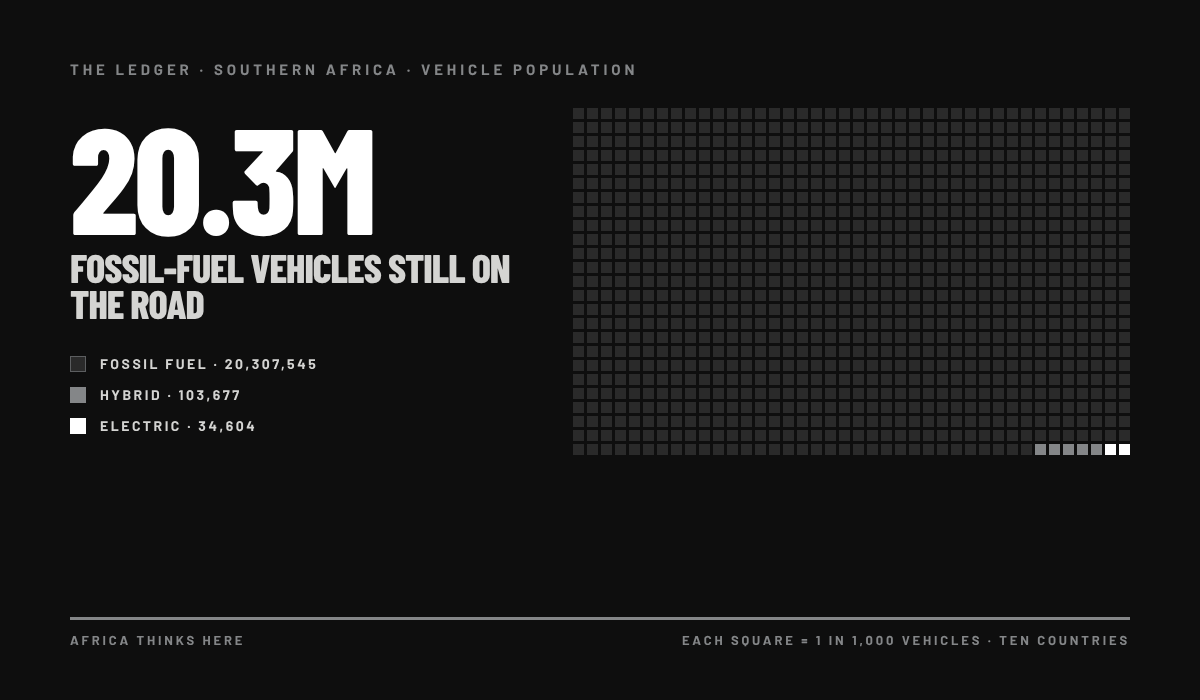
Southern Africa has 20,307,545 fossil-fuel vehicles on its roads, against 103,677 hybrids and 34,604 electric vehicles. Electrified vehicles make up less than 0.7% of the fleet. Read as a market size, that is not a small number. It is the entire runway, and it is why charging is an infrastructure investment rather than a niche service.
The ground. The fleet is concentrated:
| Country | Registered vehicles | Source |
|---|---|---|
| South Africa | About 13.6 million | TopAuto |
| Mozambique | 1,394,893 (2025) | National Statistics Institute |
| Angola | About 1.27 million light vehicles | Ministry of Transport |
| Zimbabwe | About 1.2 million | ZINARA |
| Zambia | About 854,000 | RTSA |
| Mauritius | 746,961 | allAfrica |
| Botswana | 654,276 | Statistics Botswana |
| Namibia | 419,716 | Observer24 |
| Malawi | 250,000 (last published figure) | Nyasa Times |
| Seychelles | 42,620 | Seychelles Licensing Authority |
Across these ten countries, about 993 vehicles in every 1,000 run on petrol or diesel.
Almost every litre of that fuel is imported. Every country in the region except Angola pays for its transport fuel in foreign currency, and the pressure shows: Malawi’s fuel crisis is now driving its first electric vehicle programme, and Windhoek is regulating charging as residents switch on price.
The mechanism. The value of a charging network is not set by today’s electric fleet. It is set by the rate at which the fossil fleet turns over. Vehicles in the region are kept longer than in Europe, and much of the fleet arrives second-hand. The conversion therefore runs through new-vehicle sales first, and then through the used-import pipeline years later. South Africa is already showing the first stage. In the first nine months of 2026, battery electric cars and plug-in hybrids together came to 11,299 sales, against 3,826 in all of 2025.
Every converted vehicle moves a fuel bill from the importer to the electricity grid – and, where a charger sits between them, to the charging operator. A network gains revenue on each conversion, and it does not have to wait for the whole fleet to change. It only needs a growing share of new vehicles on the routes it covers.
The consequence. This changes how a business should model a charging investment. A model built on today’s 34,604 electric vehicles will always look marginal. A model built on the conversion rate of 20.3 million vehicles – even at one or two per cent of the fleet a year – describes a market several times larger within a decade. The investors already funding charging in other regions price on the runway, not the starting count.
It also changes who should be building. Utilities, fuel retailers and property owners hold the three inputs a network needs: power, sites and traffic. Fuel retailers in particular face a choice. Their forecourts are where the fossil fleet already stops. Adding charging protects their position as that fleet converts; ignoring it hands the customer to whoever installs the first charger down the road.
The decisive close. The size of the Southern African charging market is not 34,604 vehicles. It is 20.3 million vehicles that will be replaced, one sale at a time, over the next two decades. The businesses that build the charging base now, while the count is small and sites are cheap, will be collecting on the conversion when it accelerates.
Sources
- TopAuto – South Africa’s registered vehicles
- RTP – Mozambique’s vehicle fleet nears 1.4 million
- Horizontes Viver Angola – Angola’s electric cars and light vehicle fleet
- Herald – Zimbabwe’s vehicle population tops 1.2 million
- Mwebantu – Zambia’s vehicles increase to 853,909
- allAfrica – Mauritius vehicle fleet
- Statistics Botswana – Transport and Infrastructure Statistics Report 2024
- Observer24 – Namibia’s registered vehicle fleet grows to 419,716
- Nyasa Times – Malawi’s vehicle population hits 250,000
- Nation – 42,620 vehicles on Seychelles roads
- Malawi24 – Malawi’s fuel crisis drives electric mobility push
- New Era – Windhoek moves to regulate EV charging
- CNBC Africa – South Africa’s EV sales 2026
- CleanTechnica – BEV sales in South Africa in 2025