
Debt for Energy: How Bondholders Backed Zambia’s US$1.36bn Buyback
For most of the past decade, Zambia's sovereign debt and its energy shortages have been treated as separate crises — one a problem for the finance ministry, the other for ZESCO and anyone trying to keep the lights on. A deal struck in June 2026 ties them together....
What Could Derail Liuwa Plain, Bangweulu and Community Conservation?
Remoteness is what makes Zambia's wetland destinations valuable, and remoteness is what could sink them. The same distance that keeps Liuwa Plain and Bangweulu wild - far from cities, roads and reliable power - is the distance that makes them expensive to run and hard...
The US$200m Holiday: How Zambia’s Fuel-Tax Relief Burned Through the Treasury
Cutting taxes on fuel is the easiest popular decision a government can make and one of the hardest to unwind. Zambia has just totalled the bill. Finance Minister Situmbeko Musokotwane said suspending VAT and excise duty on petroleum products cost the Treasury about...
The Cobalt Gap: Why Zambia Exported More Than It Mined, 2019–2024
An economy cannot export more of a metal than it digs out of the ground — unless the accounting, the stockpiles or the supply chain are telling more than one story. Zambia appears to have done exactly that. Mines Minister Paul Kabuswe told Parliament the country...
The Governance Test Behind Lower Zambezi: Tourism, Conservation and Development Pressure
Zambia is rarely forced to choose between two forms of prosperity. In the Lower Zambezi, it is. The valley that draws safari operators, anglers, photographers and lodge investors sits on ground that extractive investment would also like to reach. Both routes promise...
This Month’s Issue
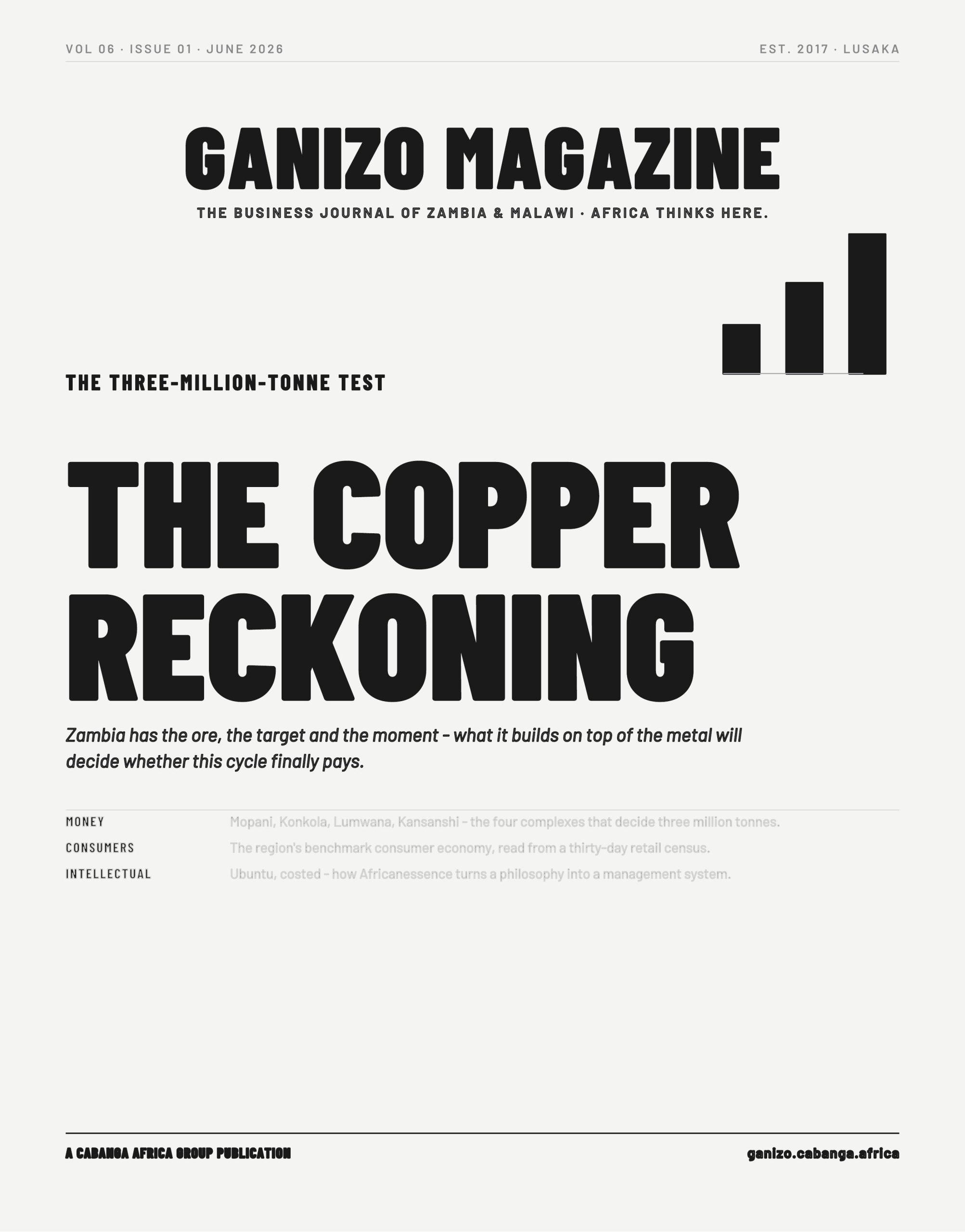
The Copper Reckoning
How Zambia turns three million tonnes into public value – or watches the boom leak away through a price and an ownership structure it does not set.
- 01 Copper and the Zambian State: Growth Versus Public Value
- 02 Konkola: Reading the Evidence, 2022-2026
- 03 The Needle Eye Review: Consumer Power in Zambia, Botswana and Zimbabwe

Debt for Energy: How Bondholders Backed Zambia’s US$1.36bn Buyback
Zambia won near-unanimous bondholder backing to buy back a US$1.36bn bond using a US$600m AfDB loan, committing up to US$275m over 15 years to grid

Domestic Tourism as Zambia’s Resilience Market Across the Decades
How Zambia’s tourism sector shifted from an export model aimed at foreign visitors towards domestic travellers, affordable park access and local events.

What Success Would Look Like in Liuwa Plain, Bangweulu and Community Conservation
What success looks like for Zambia’s community-linked wetlands by 2031: durable low-volume, high-impact destinations and the indicators to track.
Economics
What Could Derail Liuwa Plain, Bangweulu and Community Conservation?
Remoteness is what makes Zambia's wetland destinations valuable, and remoteness is what could sink them. The same distance that keeps Liuwa Plain and Bangweulu wild - far from cities, roads and reliable power - is the distance that makes them expensive to run and hard...
The US$200m Holiday: How Zambia’s Fuel-Tax Relief Burned Through the Treasury
Cutting taxes on fuel is the easiest popular decision a government can make and one of the hardest to unwind. Zambia has just totalled the bill. Finance Minister Situmbeko Musokotwane said suspending VAT and excise duty on petroleum products cost the Treasury about...
The Cobalt Gap: Why Zambia Exported More Than It Mined, 2019–2024
An economy cannot export more of a metal than it digs out of the ground — unless the accounting, the stockpiles or the supply chain are telling more than one story. Zambia appears to have done exactly that. Mines Minister Paul Kabuswe told Parliament the country...
Money
Debt for Energy: How Bondholders Backed Zambia’s US$1.36bn Buyback
For most of the past decade, Zambia's sovereign debt and its energy shortages have been treated as separate crises — one a problem for the finance ministry, the other for ZESCO and anyone trying to keep the lights on. A deal struck in June 2026 ties them together....
Domestic Tourism as Zambia’s Resilience Market Across the Decades
For most of its history, Zambia's tourism industry sold itself to people who did not live in Zambia. The brochures, the trade stands, the pricing assumptions all pointed outward, towards the long-haul visitor who arrived by air, paid in US dollars and measured a...
What Success Would Look Like in Liuwa Plain, Bangweulu and Community Conservation
It is easy to say what failure looks like in conservation - empty lodges, dwindling wildlife, communities that turned against a project because it never paid them. Success is harder to picture, because it is quieter. For Zambia's community-linked wetlands, success by...
Lifestyle
Domestic Tourism as Zambia’s Resilience Market Across the Decades
For most of its history, Zambia's tourism industry sold itself to people who did not live in Zambia. The brochures, the trade stands, the pricing assumptions all pointed outward, towards the long-haul visitor who arrived by air, paid in US dollars and measured a...
The Four-Year Shift in Liuwa Plain, Bangweulu and Community Conservation
In conservation, as in any capital-intensive sector, there are two kinds of progress: the kind that shows up on a measurement, and the kind that shows up in a press release. The four years from 2022 to the middle of 2026 have produced plenty of both across Zambia's...
Before the Current Boom: Reconstructing Liuwa Plain, Bangweulu and Community Conservation
Long before Liuwa Plain and the Bangweulu wetlands appeared on an investor's map, they were governed - by traditional authority, by the rhythm of the flood, and by communities whose claim to the land predates any protected-area boundary. The current interest in...
What Success Would Look Like in Liuwa Plain, Bangweulu and Community Conservation
What success looks like for Zambia’s community-linked wetlands by 2031: durable low-volume, high-impact destinations and the indicators to track.

What Lower Zambezi: Tourism, Conservation and Development Pressure Could Mean for Zambia by 2031
Can Zambia make landscape protection pay by 2031? Three scenarios for the Lower Zambezi and the indicators that will show which road the country took.

The Next Frontier in South Luangwa and the Economics of Safari Excellence
Forward scenarios for South Luangwa to 2031: a safari model where quality finances landscapes and local prosperity, and the indicators that reveal which path
The TEDA template: What a Suez park reveals about exporting Chinese industry
China did not just build a factory in Egypt – it copied a whole development model from Tianjin to the Red Sea. Whether that template travels to the rest of Africa is the real test.
Learning Zones: Chinese Parks Transfer Plenty of Jobs, Less of the Knowledge
Chinese zones in Ethiopia are pitched as classrooms for industrialisation. The evidence shows they teach hands well and managers rarely, leaving the deeper learning largely unrealised.

China’s Zone Playbook: An Export, but One That Resists Copy-Paste
China turned four coastal experiments into a growth engine and now markets the recipe to Africa. The World Bank’s own verdict is that the method travels far better than the results.
From Strategic Thought To Decisive Action.
Moakanyi reports the market. The wider Cabanga ecosystem
helps you lead it — media, infrastructure and growth, one system.
Intelligence
Business media across Africa’s real economy.
Infrastructure
Websites engineered as your headquarters.
Growth
Marketing that turns visibility into revenue.
04
ACADEMY
The Digital Navigator Certification.

Buy Zed: How the Indigenous Brands Push Aims to Lift Local Manufacturing
Zambia’s Indigenous Brands initiative and #BuyZed campaign aim to lift local manufacturing by building consumer demand for Zambian brands under the 24-hour
China-Africa Expos: When Headline Deal Values Outrun Signed Contracts
The Changsha expo closed with US$11.4 billion in signed projects and a further US$43 billion merely announced. The gap between the two numbers is the story.

Sports Revival Faces Gear Shortages
Schools have restarted sports but are short of equipment pending ministry approval – a small bottleneck that retailers and grant programmes are placed to clear.

Book Review: Pin The Location – Find, Convert & Keep Customers, Anywhere!
Author: Oscar Habeenzu Published: June 2023 Publisher: BehaviourReport.com Pages: 42 The Geography of Digital Customer Acquisition In an era where businesses obsess over the latest marketing automation tools and AI-driven personalization, Oscar Habeenzu's Pin The...

Digital Assets and Software: IP in Africa’s Digital Economy
The Digital Shift and the Rise of Intangible Business Assets Africa’s digital economy is expanding faster than any other region. Even traditional sectors are adopting digital platforms, apps, software systems and cloud-based operations. This transformation has created...

The Mirage of Followers: Why Virality Isn’t Stability
The social media era seduces businesses with big numbers: 100,000 followers, a million views, trending hashtags. These numbers sparkle like treasure-but too often, they’re fool’s gold. Virality may bring fleeting applause, but it doesn’t guarantee sustainable sales,...